Offshore · Energy
Below nomination again. Which unit is holding the field back?
Export is below nomination and every hour has a price. The unit limiting production changes during the day, and the evidence sits in five systems. An offshore twin keeps the constraint ladder current, so the control room moves the right setpoint first.
The problem: the constraint moves and the spreadsheet does not
A gas field sells against a nomination. When export falls short, the gap is deferred revenue, and on most assets it is priced by the day. The hard part is not knowing that production is low. It is knowing why, right now.
Production is limited by one unit at a time. In the morning it may be compression, by lunch the dehydration train, after a trip a separator level. The engineers usually know the ladder of constraints, but it lives in a spreadsheet updated once a shift, while the evidence lives in the DCS historian, the lab system, the maintenance system, the cameras and the nomination portal. By the time the spreadsheet agrees with the plant, the binding unit has moved again.
The demo field, Halcyon Field, shows the pattern. It is an offshore gas field with two platforms and a 142 km export line. Export is 508.6 MMscf/d against a nomination of 530, and the deferment is about $141k a day (demo figures).
The control room should argue about the right valve, not the right spreadsheet.
Who this is for
- Offshore installation managers and production supervisors who own the daily number
- Process and production engineers who maintain the constraint ladder
- Asset managers and commercial teams who answer for the nomination
- HSE leads who watch flare permits and restricted zones on the same assets
What the twin joins up
Synopton keeps a live twin of the field and connects read-only to what is already there: the DCS and process historians, LIMS, the CMMS, CCTV and video analytics, the nomination portal and the field's 3D model.
On one model those sources answer the questions the morning meeting keeps asking:
- Which unit is binding production now, and which one sits behind it.
- How far below nomination that leaves export, and what it costs per day.
- Which setpoint relieves it, inside which limits, and what it is worth.
- Whether an instrument or a camera is telling the truth.
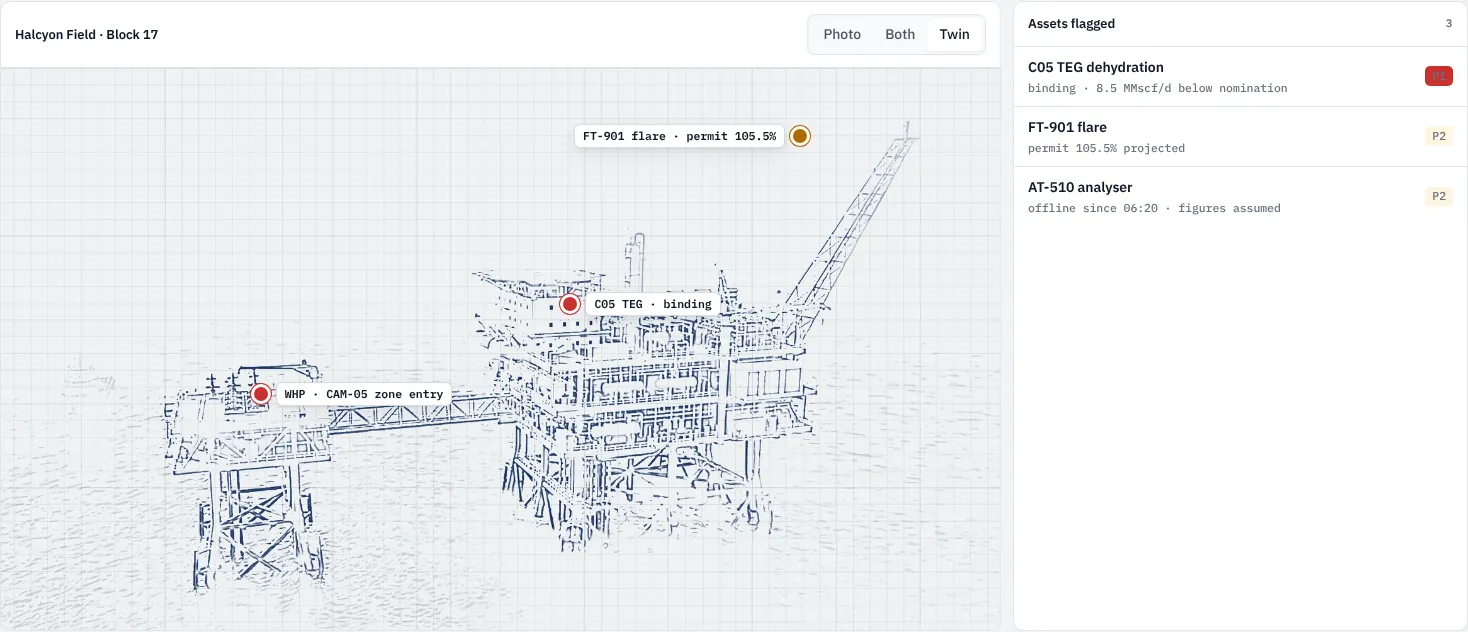
On the Halcyon model, C05 TEG dehydration carries a red pin marked "binding". The asset list beside it adds the FT-901 flare at a projected 105.5 % of permit and the AT-510 water analyser, offline since 06:20.
From a binding unit to an agreed decision
The demo replays one shift. At 08:30 the shift hands over and every system is reporting. At 08:41 C05 dehydration becomes the binding constraint, with 521.5 MMscf/d of gas through it. At 08:44 the twin prices the fix and shows its working: raise the reboiler from 384 to 386 °F, recovering 8.5 MMscf/d, inside the OEM envelope and without a change request. The rule is DH-02 version 2.1 and the owner is the production lead, with four hours to act.
At 08:52 the OIM agrees and the decision is logged as DS-0142. The twin then follows the result rather than closing the ticket. Export climbs toward 517.1 MMscf/d and the deferment falls from $141k to $87k a day. The remaining gap is now visible as the next rung of the ladder, not as a surprise at the next morning meeting.
When the data disagrees
The same field shows why a twin has to be honest about its inputs. The flare meter FT-901 projects 92 % of the monthly permit. Camera CAM-03, watching the same flare, projects 105.5 %. They have disagreed since 04:10. The twin does not pick the convenient number. It flags the conflict and recommends sending the instrument technician to prove FT-901 against the camera before the monthly permit return.
The AT-510 analyser on the export line is offline, so export water content is switched to assumed at 6.80 lb/MMscf against a 7.00 spec. The twin warns on every decision that depends on it and recommends holding export under 522 MMscf/d until the analyser is back, rather than running blind within half a pound of spec.
Why the numbers hold up
Every figure in Synopton carries a provenance label: measured, modelled, published, assumed or forecast. Press Why? on the reboiler change and the panel lists its inputs. The reboiler at 384 °F is measured. The OEM limit of 390 °F is published, from the manual. Lean glycol purity of 98.90 wt% is measured from the lab. Export water content is assumed, because its analyser is down.
Ask the twin "why are we below nomination?" and the answer names the binding constraint, the gap, its daily cost and the fix, each with a citation: the constraint ladder (modelled), the nomination portal for the gas day (published), and the rule and OEM manual (published). Answers that cannot be cited are not shown.
Nothing is written back to the plant. Connectors are read-only. Accepting a recommendation drafts a decision record for people to agree, and a person moves the setpoint.
See it running
The live console opens on Halcyon Field with demo data, next to a hotel, a construction site and an office tower. Open the Twin tab to see C05, the flare and the export line pinned on the model, ask the twin why the field is below nomination, then replay the shift on the decision board. The offshore and energy page covers what an energy twin watches beyond production, from flare permits to consumables, and the platform page explains how a figure becomes a decision record.
What it costs
We quote after a 30-minute scoping call. The pilot runs on one asset with your own data for a fixed fee agreed at scoping, credited against the first year if you continue. After that, Site is an annual subscription per asset, scaled by the number of connected sources and cameras, and Portfolio puts many assets under one agreement. See how the pilot works.
Find the unit that is costing you the nomination
Tell us the asset, the systems you run and where the gap to nomination hurts most. Email info@synopton.com or book a scoping call, and you get the full demo straight away.
Questions buyers ask
Does Synopton write to the DCS?
No. Connectors are read-only. A recommendation drafts a decision record for people to agree; nothing is written back to plant systems.
Our data is messy. Is that a problem?
It is normal. Anything that cannot be measured is labelled as assumed, and the data health screen shows which instruments have gone quiet.
Does it only work for gas?
No. The same approach covers platforms, terminals and plants where an hour of deferment has a price and one unit limits output at a time.
Can it run in our own cloud?
Yes, if you prefer. We host it, or it runs in your own cloud tenancy, with single sign-on, role-based access and every answer and decision logged.
Your site, your data
Want to see which unit is holding your field back?
Tell us the asset and the question it has to answer. You get the full demo straight away, and we come back within one working day to book 30 minutes.