Hospitals
A hospital digital twin that shows why the ED is full.
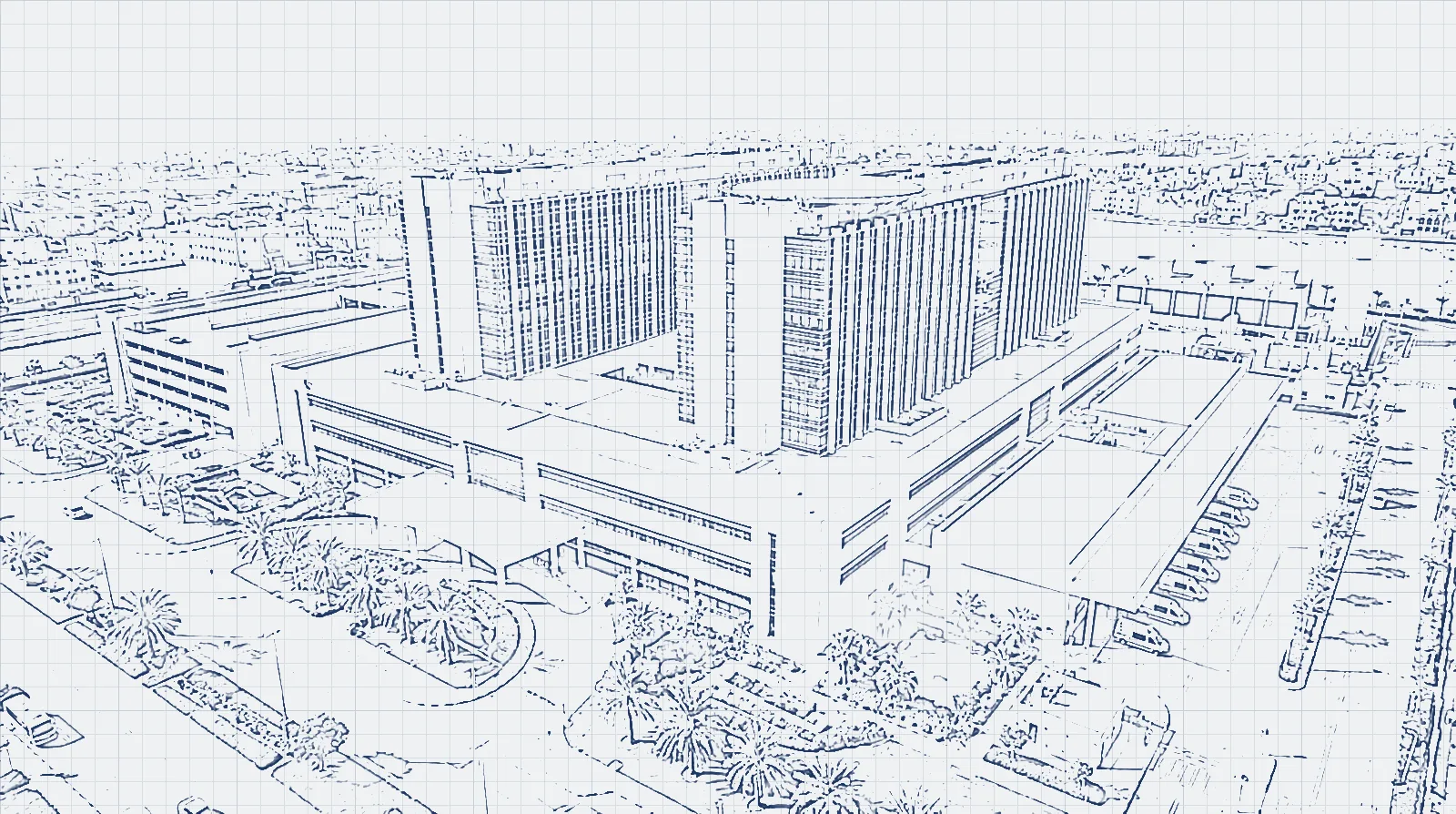
Synopton builds a live 3D twin of your hospital and connects it to ED tracking, the bed-management system, the BMS, medical equipment monitoring, pharmacy cold chain and CCTV. Every bed, theatre and fridge sits on the floor where it is, with a cost attached.

Why the ED fills by lunchtime
Most acute hospitals discharge as many patients a day as they admit.
The beds come free in the afternoon. The ED needs them from late morning.
Discharge times sit in the patient administration system, boarding in ED tracking, handovers in the ambulance log and the deductions in a health-authority contract. So a ward fills, an escalation bed ends up in a fire-escape corridor, crews wait at the door and elective lists are cancelled for want of a bed. Each report shows one piece. Joined up, the cause is usually the hour patients leave.
What the hospital twin watches
Every signal is tied to a ward, a bed, a theatre or a piece of plant.
The twin watches
- ED occupancy against treatment spaces, forecast hour by hour
- Boarding time from decision to admit to a ward bed
- Patients fit to leave, by ward and by what still holds them
- Ambulance handovers against the 30-minute target
- Theatre air changes, MRI helium and pharmacy fridges, each with a runway
- Escape routes and theatre doors on camera, faces blurred at source
Decisions it drives
- When to open a discharge lounge, and what it returns
- Which beds free first, and who unblocks each one
- Which list moves when a theatre drifts out of specification
- When to order a repair inside the lead time
How it works in a hospital
Read-only connections, a 3D model and a record of every decision.
- Connect. Read-only links to ED tracking, bed management and patient administration, the BMS, medical equipment and cryogen monitoring, pharmacy cold-chain probes, the CMMS and change calendar, the ambulance handover log and CCTV.
- Model. A 3D twin built from floor plans, the fire strategy and the equipment register, or loaded from your BIM, with wards, theatres, plant and cameras placed where they really are.
- Label. Every figure carries a provenance chip (measured, modelled, published, assumed or forecast) and a Why? panel that shows its inputs.
- Ask. Plain questions such as “why are patients waiting in the ED?” come back with answers that cite the twin’s own data.
- Decide. Accepting a recommendation drafts a decision record with an owner and a deadline, and the twin then tracks the measured result. Nothing is written to a clinical or building system.
See a hospital twin running
Al Noor Medical City, in the demo.
Al Noor Medical City, a 520-bed tertiary hospital with a 62-space ED, is fully built in the interactive demo. Beds are 97% occupied and 31 patients who are fit to leave still hold one, because only 18% of discharges happen before noon. The ED is forecast to peak at 167% at 13:00, and admitted patients wait 7.5 hours for a bed against a 4-hour target. The twin models a 24-chair discharge lounge in an existing level-1 waiting area, plus a step-down fast-track for 7 patients waiting on a placement. Boarding falls to 4.9 hours today and 2.8 hours from tomorrow, the ED peak drops to 149%, and the lounge nets AED 3.2m a year after staffing.
IN THE DEMODemo names and figures are illustrative.
Questions buyers ask
Do we need a BIM model of the hospital?
No. We build the 3D twin from floor plans, the fire strategy and the equipment register. If you have BIM, IFC or GLB models, we load them.
Does Synopton write to our clinical or building systems?
No. Connectors are read-only. Accepting a recommendation drafts a decision record for people to agree; nothing is written to the patient record, the bed-management system or the BMS.
How are patient data and camera footage handled?
The twin works on bed states, counts and timestamps, never clinical notes. Patient references are masked by default and revealing one is written to the audit log. Faces are blurred at source, and camera detectors flag operational events, such as a bed in an escape corridor, never who a person is.
How soon is the twin useful?
The twin is usable from week six of a 90-day pilot, and your team runs real decisions through it in weeks seven to twelve.
Other industries
The same platform runs twins of other assets that can’t stop.