Hospitals · Patient flow
The ED is full by lunchtime. The beds free up at three.
Most acute hospitals discharge as many patients a day as they admit. The trouble is the hour. Beds come free in the afternoon and the ED needs them from late morning. A hospital twin puts the ED forecast and the bed board on one model, so the morning bed meeting can see which beds free first and who unblocks each one.
The problem: the right number of beds at the wrong hour
ED crowding is usually treated as a front-door problem. More attendances, more staff, more cubicles. In many acute hospitals the front door is not the cause. Admitted patients board in the ED because no ward bed is free yet, and the cubicles they hold are the ones new patients need.
The data that explains it is spread across systems. Discharge times sit in the patient administration system, boarding in ED tracking, handovers in the ambulance log, and the deductions in a health-authority contract. Each report shows one piece, so the morning bed meeting argues about symptoms.
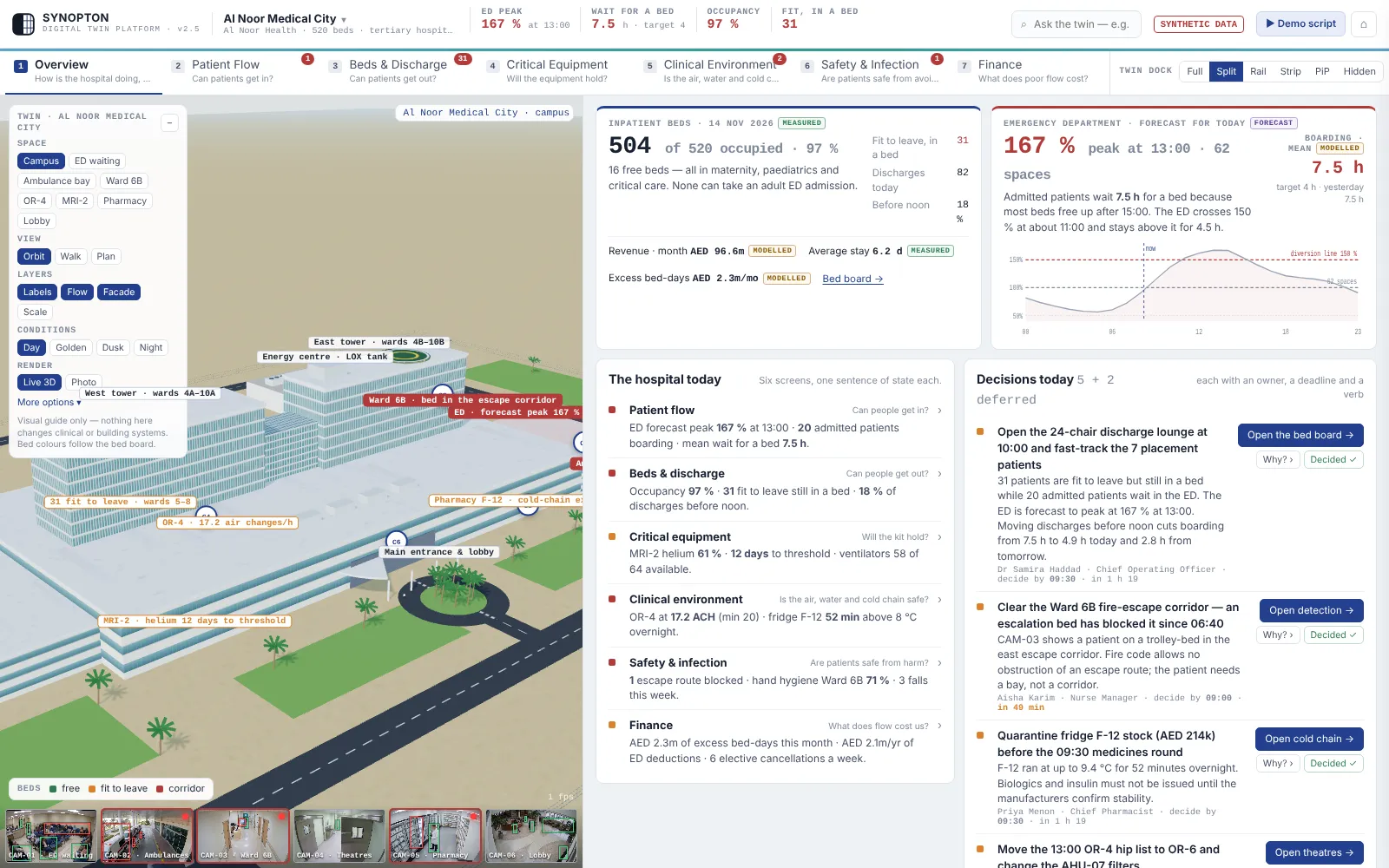
The demo hospital, Al Noor Medical City, shows the pattern (demo figures). It has 520 beds and a 62-space ED. At 08:00, 504 beds are occupied, 97 %, and the 16 free beds are all in maternity, paediatrics and critical care. 31 patients who are fit to leave still hold a bed, because only 18 % of discharges happen before noon. 20 admitted patients are boarding in the ED. The ED is forecast to cross 150 % at about 11:00 and peak at 167 % at 13:00. Admitted patients wait 7.5 hours for a bed against a 4-hour target.
The hospital does not need more beds today. It needs 24 of them three hours earlier.
Who this is for
- Chief operating officers and directors of patient flow who run the bed meeting
- ED clinical leads living with boarding and ambulance handover delays
- Chief nursing officers and ward managers who own discharge
- Finance teams carrying excess bed-days and contract deductions
What the twin joins up
Synopton builds a live 3D twin of the hospital and connects read-only to what is already there: ED tracking, bed management and patient administration, discharge records, the ambulance handover log, the BMS, medical equipment monitoring, pharmacy cold chain, the CMMS and CCTV. Every ward, bed and theatre sits on the floor where it is.
On one model, those sources answer the questions the bed meeting keeps asking:
- ED occupancy against treatment spaces, forecast hour by hour, and when it crosses the line.
- Boarding time from decision to admit to a ward bed.
- Patients fit to leave, by ward, and what still holds each one: medicines, transport, a letter, family or a placement.
- Ambulance handovers against the 30-minute target.
The discharge lounge, priced
The demo replays one morning. At 08:10 every system is reporting. At 08:22 the forecast shows the ED at 167 % by 13:00, with 31 fit patients still in beds. Of those 31, 24 are waiting only for something non-clinical: their medicines, transport, a discharge letter or a relative. 7 are waiting for a placement.
At 08:31 the twin models a 24-chair discharge lounge in an existing level-1 waiting area, open 10:00 to 20:00, staffed by two nurses, a healthcare assistant, half a pharmacist and a porter. Pharmacy runs the take-home medicines batch to the lounge at 11:00. The 7 placement patients go to step-down care the same day. The 24 beds come back by 11:30 and go to the ED boarders first.
The result, modelled on the demo data:
- Boarding falls from 7.5 hours to 4.9 hours today and 2.8 hours from tomorrow.
- The ED peak drops from 167 % to 149 %, under the 150 % line.
- Discharges before noon rise from 18 % to 48 %.
- The lounge costs AED 180k to fit out and AED 1.15m a year to run, and nets AED 3.2m a year after staffing.
The recommendation runs under rule FLOW-03 version 1.1: a patient who is medically fit and waiting only for a non-clinical step waits in the lounge, not in a bed, and the bed is cleaned and offered to the ED within 60 minutes. The owner is the chief operating officer, decide by 09:30. It is approved at 09:05.
What the late discharge is already costing
In the demo, 780 bed-days this month were spent by patients who no longer needed a hospital bed, about AED 2.3m. The health-authority contract deducts AED 1,300 for every hour the ED sits above 150 %, which at today's pattern of 4.5 hours a day is AED 2.1m a year. Six elective cases a week are cancelled on the day for want of a bed, four of them before 10:00. 11 of 74 ambulance handovers today ran over 30 minutes.
The same twin flags the safety side. CAM-03 shows a patient on a trolley-bed in the Ward 6B escape corridor since 06:40. Fire code allows no obstruction of an escape route, so the twin gives that patient the first free bay.
Why the numbers hold up
Every figure carries a provenance label: measured, modelled, published, assumed or forecast. Press Why? on the lounge and the panel lists its inputs. Discharges before noon, 18 %, is measured from discharge timestamps. The 24 of 31 who need only a chair is measured from the discharge checklist. The 149 % peak is modelled. The lounge running cost is assumed from the nursing establishment model.
Ask the twin "why are patients waiting in the ED?" and the answer cites its own data line by line, so the case can go to the executive team with its working attached.
Connectors are read-only. Accepting a recommendation drafts a decision record with an owner and a deadline; nothing is written to the patient record, the bed-management system or the BMS. The twin works on bed states, counts and timestamps, never clinical notes.
See it running
Al Noor Medical City is fully built in the interactive demo: the ED and ambulance bay, the ward towers, the discharge lounge, theatres, MRI and pharmacy, with the decisions above on the board. The hospital page covers what the twin watches across a site, and the platform page explains how a figure becomes a decision record.
What it costs
We quote after a 30-minute scoping call. The pilot runs on one hospital with your own data for a fixed fee agreed at scoping, credited against the first year if you continue. After that, Site is an annual subscription per asset, scaled by the number of connected sources and cameras, and Portfolio puts many hospitals under one agreement. See how the pilot works.
Get your beds back before lunch
Tell us the hospital, the ED and the systems you run. Email info@synopton.com or book a scoping call, and you get the full demo straight away.
Questions buyers ask
Does Synopton write to our bed-management or clinical systems?
No. Connectors are read-only. A recommendation drafts a decision record for people to agree.
How are patient data and camera footage handled?
The twin works on bed states, counts and timestamps, never clinical notes. Patient references are masked by default and revealing one is written to the audit log. Faces are blurred at source.
Do we need a BIM model of the hospital?
No. We build the twin from floor plans, the fire strategy and the equipment register, and load BIM, IFC or GLB models where you have them.
Can we start with one hospital?
Yes. A pilot covers one hospital with your own data, and the fee is credited against your first year if you continue.
Your site, your data
Want to see which of your beds free up first?
Tell us the asset and the question it has to answer. You get the full demo straight away, and we come back within one working day to book 30 minutes.