Data centres · Capacity
The tenant wants 6 MW more. Can you say yes?
A tenant asks for more megawatts and the term sheet has a deadline. The electrical team says yes, the cooling team is not sure, and billing has a third number. A data centre twin puts power, cooling and contracts on one model, so you know what you can sell, rack by rack.
The problem: three teams, three answers
Colocation and hyperscale campuses sell power and cooling by the megawatt. When the anchor tenant asks for more, the answer should take an afternoon. In practice it takes weeks of spreadsheets, because it is spread across the single-line diagram, the BMS, DCIM, UPS monitoring and the billing system.
Electrical capacity usually says yes. Air cooling often says no, and in a heat wave that limit moves every afternoon. If nobody can join the two in time, the deal goes to the campus next door.
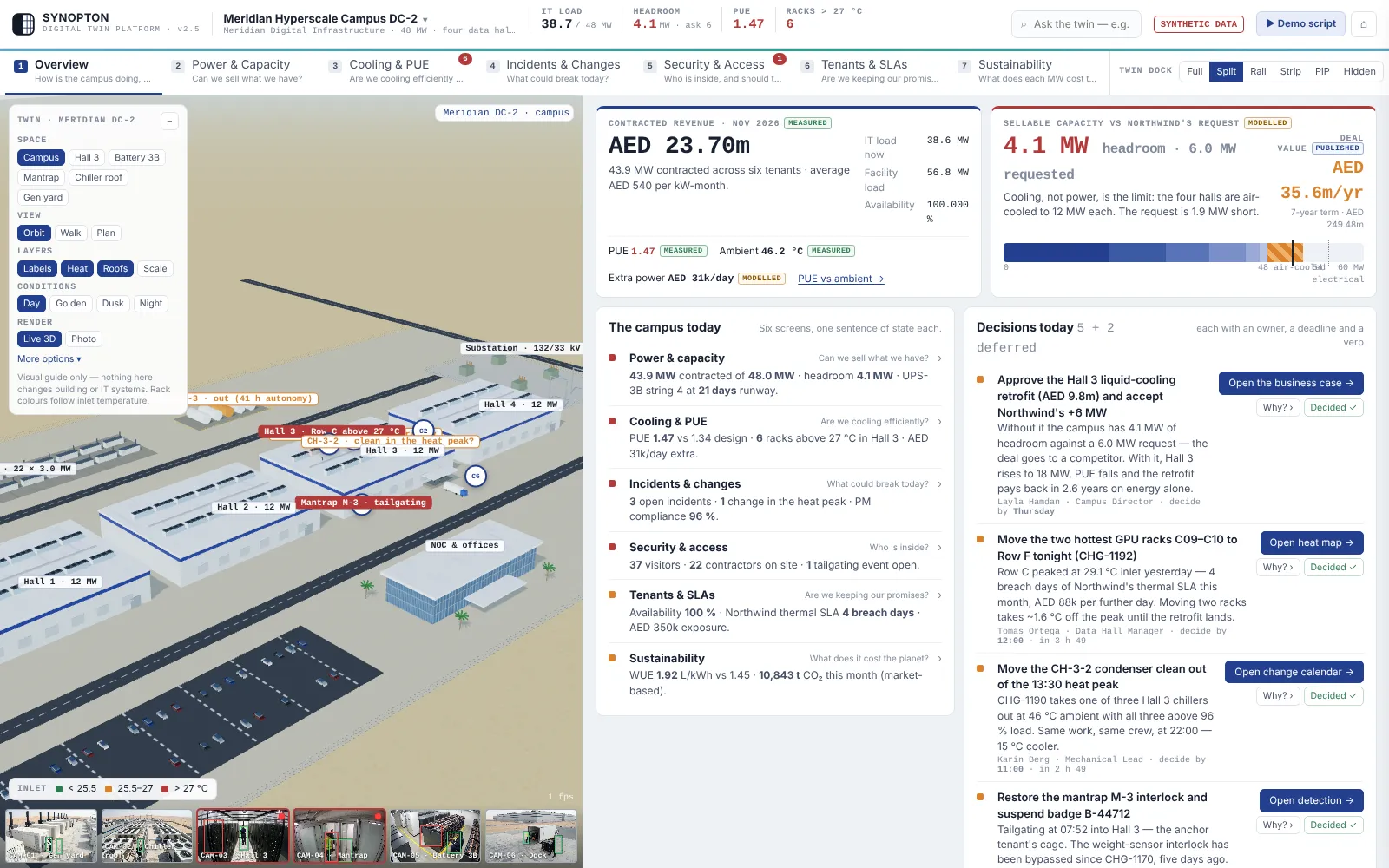
The demo campus, Meridian DC-2, shows the pattern (demo figures). It has 48 MW across four air-cooled data halls of 12 MW each and six tenants. Contracted load is 43.9 MW. On day 6 of a heat wave the anchor tenant, Northwind AI, asks for 6 MW more. Sellable headroom is 4.1 MW, so the request is 1.9 MW short. UPS-backed capacity is 54 MW. Power is not the limit. Cooling is.
Headroom is not one number. It is the lower of what the switchgear can carry and what the air can take away.
Who this is for
- Campus and data centre directors who answer capacity requests
- Commercial and sales leads holding a term sheet with a deadline
- Critical facilities and mechanical leads who own cooling and PUE
- Finance teams pricing retrofits against contracted revenue
What the twin joins up
Synopton builds a live 3D twin of the campus and connects read-only to what is already there: the BMS and EPMS, DCIM and rack PDUs, UPS and battery monitoring, the CMMS and change calendar, billing and tenant contracts, access control and CCTV. Every hall, row, rack and chiller sits on the model with its tenant and its price.
On one model, those sources answer the questions a capacity request raises:
- Sellable headroom per hall, electrical against cooling, and which one binds.
- Rack inlet temperature against each tenant's thermal SLA, and what a breach day costs.
- PUE and WUE priced at the tariff, hall by hall.
- Which planned change lands in the heat peak and removes your cooling margin.
Pricing the answer to "can we take 6 MW?"
The demo replays one morning. At 08:10 every system is reporting. At 08:24 the 6 MW request arrives against 4.1 MW of headroom. At 08:31 the twin prices a liquid-cooling retrofit of Hall 3 and shows its working: AED 9.8m, adding 6 MW, with a 2.6-year payback on energy alone, against a deal worth AED 35.6m a year on a seven-year term. Hall 3 rises from 12 to 18 MW and campus headroom goes from 4.1 to 10.1 MW. The recommendation runs under rule CAP-02 version 1.4, owned by the campus director, decide by Thursday. It is approved at 09:05.
The same model shows what to do before the retrofit lands. Row C in Hall 3 holds Northwind's GPU training pods at 42 kW per rack against a 30 kW design. Six racks, C07 to C12, are above the 27 °C thermal SLA, with a peak inlet of 29.1 °C. That is four breach days this month and AED 350k of SLA exposure. The twin recommends moving racks C09 and C10 to Row F tonight, which takes about 1.6 °C off the Row C peak.
The cost hiding in the change calendar
On the Hall 3 roof, chiller CH-3-2 is at 98 % load with all three chillers running and 46.2 °C outside air. A condenser clean is booked from 13:30 to 16:00, right in the heat peak, which would leave Hall 3 on two chillers and Row C at a modelled 30.4 °C. The twin flags it and proposes 22:00 instead: the same crew, about 15 °C cooler, and Hall 3 keeps three chillers.
None of these is visible from a single system. The change calendar does not know the weather. The BMS does not know the tenant contract. The twin joins them before the cost lands.
Why the numbers hold up
Every figure carries a provenance label: measured, modelled, published, assumed or forecast. Press Why? on the retrofit and the panel lists its inputs. Contracted capacity of 43.9 MW is measured from billing. The 48 MW air-cooled limit is published in the basis of design. The AED 9.8m retrofit quote is published. The AED 3.75m a year in energy saved is modelled.
Ask the twin "can we take Northwind's 6 MW?" and the answer cites its own data line by line, so the number can go to the commercial team and the board with its working attached.
Connectors are read-only. The twin drafts a decision record with an owner and a deadline; nothing is written back to building or IT systems. Tenant names and badge records are masked by default, and a data health screen shows which feeds have gone quiet, such as the UPS-3B battery monitor.
See it running
Meridian DC-2 is fully built in the interactive demo: the campus, Hall 3, the battery room, the mantrap and the chiller roof, with the decisions above on the board. The data centre page covers what the twin watches across a campus, and the platform page explains how a figure becomes a decision record.
What it costs
We quote after a 30-minute scoping call. The pilot runs on one campus with your own data for a fixed fee agreed at scoping, credited against the first year if you continue. After that, Site is an annual subscription per asset, scaled by the number of connected sources and cameras, and Portfolio puts many campuses under one agreement. See how the pilot works.
Find the megawatts you can sell
Send us the campus, the halls and the systems you run. Email info@synopton.com or book a scoping call, and you get the full demo straight away.
Questions buyers ask
Does Synopton write to our BMS, EPMS or DCIM?
No. Connectors are read-only. A recommendation drafts a decision record for people to agree.
Do we need a BIM model of the campus?
No. We build the twin from the basis of design, single-line diagrams, rack layouts and an equipment list, and load BIM, IFC or GLB models where you have them.
How is tenant data handled?
Tenant names and badge records are masked by default. Camera detectors flag events such as tailgating at a mantrap; faces are never stored.
Can we start with one campus?
Yes. A pilot covers one campus with your own data, and the fee is credited against your first year if you continue.
Your site, your data
Want to know what your campus can really sell?
Tell us the asset and the question it has to answer. You get the full demo straight away, and we come back within one working day to book 30 minutes.