Smart districts
A district digital twin that runs event night before it happens.
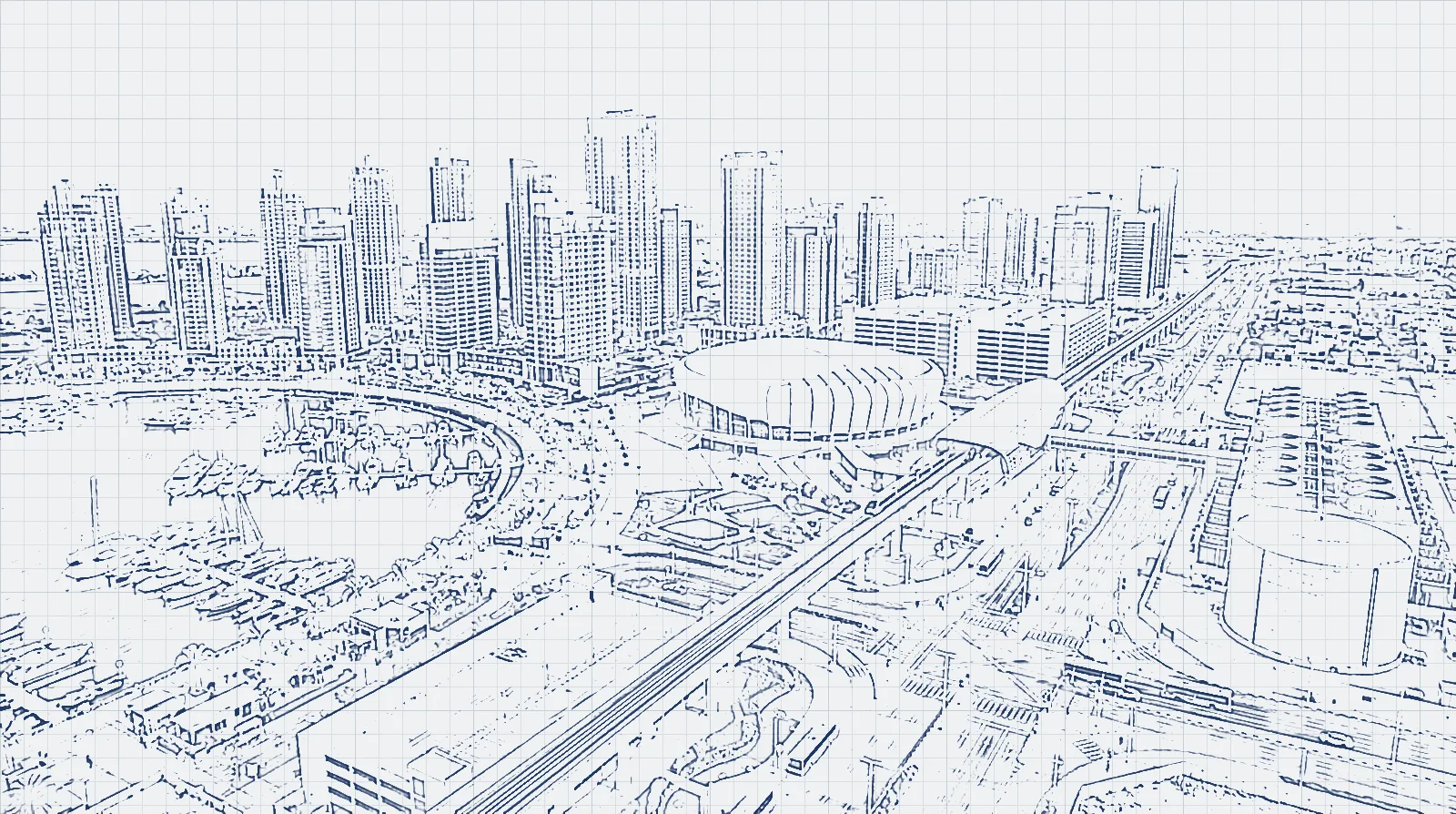
Synopton builds a live 3D twin of your district and connects it to signal controllers and loop detectors, parking guidance, district cooling, the street-lighting CMS, utility meters and CCTV. Every junction, chiller, light and bin sits on the map with an owner and a price attached.

Why event nights cost more than they should
Master developers and district operators run roads, cooling, public realm and services for tens of thousands of people.
A sold-out concert lands on the evening commute, and each team plans its own part of the night.
Mobility sees the junction. Energy sees the chiller plant. Public safety sees the metro concourse. Nobody sees that the thermal storage tank is scheduled to run empty at 16:00, just as the arena starts pre-cooling, or that the walking route home has 14 lights out. Each risk looks small in its own system. Joined up, it is a 30-minute queue, a cooling plant with no spare chiller and AED 310k of lost time in one evening.
What the district twin watches
Every signal is tied to a junction, a garage, a chiller or a street asset.
The twin watches
- Junction queues against capacity, every 15 minutes
- Garage occupancy and park-and-ride uptake
- District cooling load against the standby-chiller line
- Thermal storage charge and the discharge schedule
- Crowd density at metro gates and plazas on camera
- Street lights, bins, water night flow and air quality
Decisions it drives
- Whether an event needs a mobility plan, and which levers
- When to discharge thermal storage
- Which fault gets fixed before doors open
- What an event night costs, and who pays for it
How it works in a district
Read-only connections, a 3D model and a record of every decision.
- Connect. Read-only links to signal controllers and loop detectors, parking guidance, district cooling and building BMS, the street-lighting CMS, smart bins and water meters, air-quality stations, event ticketing and CCTV.
- Model. A 3D twin built from the master plan, road and utility drawings and an asset register, or loaded from your BIM and GIS, with junctions, plant and cameras placed where they really are.
- Label. Every figure carries a provenance chip (measured, modelled, published, assumed or forecast) and a Why? panel that shows its inputs.
- Ask. Plain questions such as “how bad will traffic be tonight?” come back with answers that cite the twin’s own data.
- Decide. Accepting a recommendation drafts a decision record with an owner and a deadline, and the twin then tracks the measured result.
See a district twin running
Saraya Bay District, in the demo.
Saraya Bay District, a waterfront district of 42 buildings and 48,000 residents with an arena, a metro station and a district cooling plant, is fully built in the interactive demo. Crescent Arena hosts a sold-out 24,000-seat concert at 20:00 on day 4 of a heat wave. With no plan, the queue at junction J-7 peaks at 30.9 minutes and the garages fill at 19:45. Retimed signals, three park-and-ride loops and live parking guidance cost AED 118k and cut the peak to 10.2 minutes. That saves about 5,200 person-hours and nets AED 152k a night, AED 5.16m a year over 34 events. The twin also catches the cooling plant: with the tank empty at 16:00, DCP-1 runs at 98% with no standby chiller from 16:00 to 20:00. Spread to 21:00, the same storage holds the peak at 89% with a chiller in reserve.
IN THE DEMODemo names and figures are illustrative.
Questions buyers ask
Do we need a BIM or GIS model of the district?
No. We build the 3D twin from the master plan, road and utility drawings and an asset register. If you have BIM, IFC, GLB or GIS layers, we load them.
Does Synopton change signal timings or chiller settings?
No. Connectors are read-only. Accepting a recommendation drafts a decision record for people to agree; nothing is written to a signal controller, a valve or a chiller.
How is camera footage of the public handled?
Cameras count and classify; they do not identify anyone. Faces and number plates are blurred at source, and revealing a plate is written to the audit log with the user’s name and reason.
How soon is the twin useful?
The twin is usable from week six of a 90-day pilot, and your team runs real decisions through it in weeks seven to twelve.
Other industries
The same platform runs twins of other assets that can’t stop.