Hotels · Warranties
Claim the warranty before you buy the part
A fan-coil unit fails for the third time, a replacement quote lands on the approvals queue and someone signs it. The unit was still under warranty. A twin that joins the warranty register, the CMMS and purchasing stops that order before it is paid.
The problem: the warranty exists, nobody checks it
Every new building is handed over with a pile of warranties. Chillers, pumps, lifts, fan-coil units, kitchen equipment, each with its own start date and its own clock. They live in O&M manuals, a handover spreadsheet and the supplier's certificate. The CMMS knows what broke. Procurement knows what is being bought. Nothing connects the three.
So when a unit fails, the quickest route wins. The engineer raises a job, a supplier quotes a replacement, the order goes for approval and gets signed. Nobody asks whether the part is covered, because answering means finding the right certificate and working out how many months are left on it.
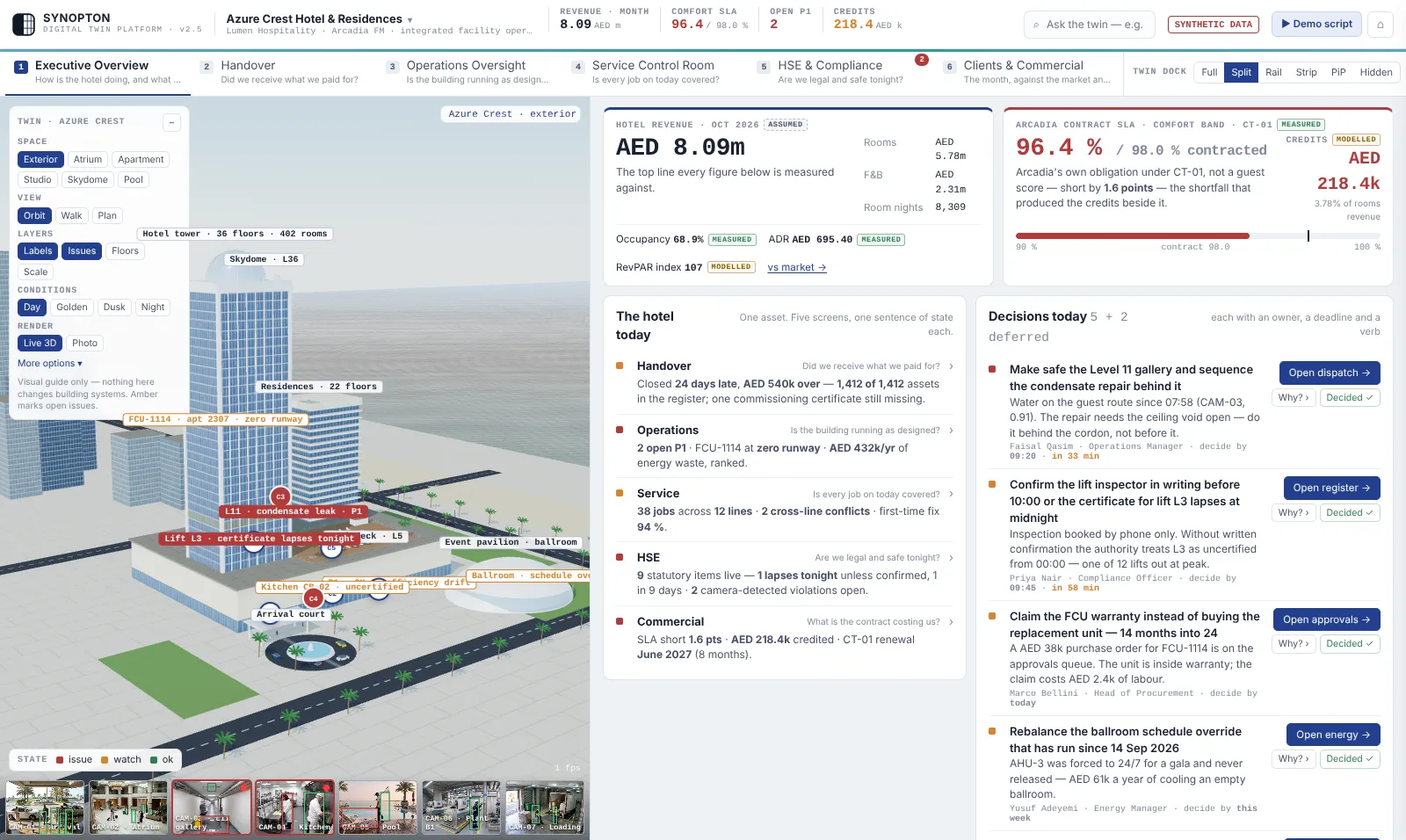
The demo hotel, Azure Crest Hotel and Residences, shows how it plays out. FCU-1114, the fan-coil unit in apartment 2307, failed overnight. It is the third failure in 14 months, the same compressor-side PCB fault each time. The resident was moved to a suite at AED 2,150 a night. By morning a AED 38k replacement order sat on the approvals queue (demo figures).
The unit belongs to a batch of 212 FX-40 fan-coils, 14 months into a 24-month warranty. A claim costs AED 2.4k of labour. Signing the order would have spent AED 35.6k the hotel did not need to spend.
The cheapest replacement part is the one the manufacturer already owes you.
Who this is for
- Directors of engineering and facilities managers who raise the jobs
- Procurement teams who approve repair and replacement orders
- Asset managers and owners in the first years after handover
- Developers and owner's representatives closing out a handover
What the twin joins up
Synopton builds a live 3D twin of the building and connects it read-only to the systems that already hold the pieces: the warranty register from handover, the CMMS and helpdesk, the BMS alarms, purchasing and the approvals queue, and the supplier certificates themselves.
With those on one model, the check that nobody had time for runs on every order:
- A purchase order is raised against an asset.
- The twin matches the asset to its warranty, its start date and the months used.
- If the asset is inside its warranty clock, the order is stopped at approval and routed to a claim.
- The claim cost and the purchase price sit side by side, so the saving is a number, not an opinion.
In the demo this appears in the morning's decisions as "Claim the FCU warranty instead of buying the replacement unit", with Procurement as owner and today as the deadline.
One failure, or a batch problem
A single failed unit is a repair. The same fault across a model is a batch claim, and the twin looks for that pattern across the whole portfolio. In the demo, the FX-40 model has failed 11 times across four buildings run by the same hotel group. The rule applied is plain: three or more failures of one model in two buildings opens a batch claim. So the twin drafts two documents, the claim for FCU-1114 and a batch claim for the model, both ready for the supplier.
The warranty register does the same for the rest of the plant. The domestic water pump seal kit quoted at AED 6.8k is flagged as claimable. The chillers carry a 60-month compressor warranty, so the twin warns against any compressor spend on CH-02 until its efficiency drift has been checked.
When the warranty is already lost
The register also shows the opposite case, which is often more expensive. In the demo kitchen, one commissioning certificate was never signed at handover. Without it, seven equipment warranties are void, and a AED 3.2k oven door seal has already been paid for that should have been free. The twin raises closing that certificate as its own decision, with the inspection window as the deadline, because every week it stays open costs another claim.
Why the numbers hold up
A warranty claim only works if the supplier accepts the dates. Every figure in Synopton carries a provenance chip: measured, modelled, published, assumed or forecast. Months used are measured from the warranty register, starting at handover. The replacement quote is published, from the supplier. The claim cost is modelled from the rate card. Failure counts come from the CMMS.
Press Why? on the recommendation and the panel lists those inputs, the procurement rule applied, the warranty certificate and the steps the twin took: order matched to a warranted asset, failure joined to the repeat-failure thread, claim priced against purchase, claims drafted. Ask the twin "which open orders are covered by warranty?" and the answer cites its own data.
Nothing writes back. Connectors are read-only, so the CMMS, purchasing and the BMS are never changed. Accepting the recommendation drafts a decision record with an owner and a deadline, and the outcome is tracked afterwards.
See it running
The live console shows the demo hotel's operations feed, including the FCU-1114 claim against the AED 38k order. The hotels page covers what the hotel twin watches, from handover registers to lift and kitchen certificates, and the real estate page shows the same approach across a portfolio. The platform page explains how a figure becomes a decision record. Request the full demo to open the approvals view yourself.
What it costs
We quote after a 30-minute scoping call. The pilot runs on one asset with your own data for a fixed fee agreed at scoping, credited against the first year if you continue. After that, Site is an annual subscription per asset, scaled by the number of connected sources and cameras, and Portfolio covers many assets under one agreement. See how the pilot works.
Find the claims you are missing
Send us the building, its handover date and the last few repair orders you signed. Email info@synopton.com or book a scoping call, and you get the full demo straight away.
Questions buyers ask
Our warranties are spread across PDFs and O&M manuals. Can you still use them?
Yes. We build the warranty register from the handover documents and certificates you have, then link each warranty to its asset in the twin.
Does this only work for new buildings?
It pays most in the first years after handover, when most equipment is still covered. Extended warranties, service contracts and repair guarantees work the same way at any age.
Will Synopton cancel orders in our purchasing system?
No. Connectors are read-only. The twin flags the order and drafts the claim, and your team decides. Nothing is written back to purchasing or the CMMS.
Do we need BIM to build the twin?
No. We can build it from floor plans, drawings and an equipment list. If you have BIM, IFC or GLB models, we load them.
Your site, your data
Want to know which of your repairs are still under warranty?
Tell us the asset and the question it has to answer. You get the full demo straight away, and we come back within one working day to book 30 minutes.