Logistics · Digital twin
Carrier waiting fees: what peak really costs a logistics hub
At peak, trucks queue at the gate for hours while half the inbound doors sit closed overnight. Carriers bill waiting fees, the biggest client misses its cut-off, and each loss lives in a different system. A logistics digital twin puts them on one model of the hub and prices the fix.

The problem: busy by day, idle by night
Third-party logistics hubs and retail DCs are paid per pallet and per order, and judged on the client's cut-off. At peak the pattern repeats every morning. Inbound trucks arrive before noon, the yard fills, and the queue backs out onto the road. After 22:00 the inbound doors close, so the capacity that would clear the queue sits unused.
The costs pile up in different places. Carriers bill waiting fees after two free hours. Day forklifts get split between unloading and replenishment, so pick faces run empty mid-shift. The largest client slips below its on-time target, and its contract pays a credit on every late order. Each line looks small on its own report. Added up on one hub, waiting fees and late-order credits are often the largest cost of peak you can still control.
The cheapest fix is rarely more space. It is usually a different hour.
Who this is for
- Site and operations directors at 3PL hubs and distribution centres
- Transport and yard managers who live with the gate queue
- Account directors with a large client up for renewal
- Network and real estate leads deciding between an overflow warehouse and a better schedule
What the logistics twin joins up
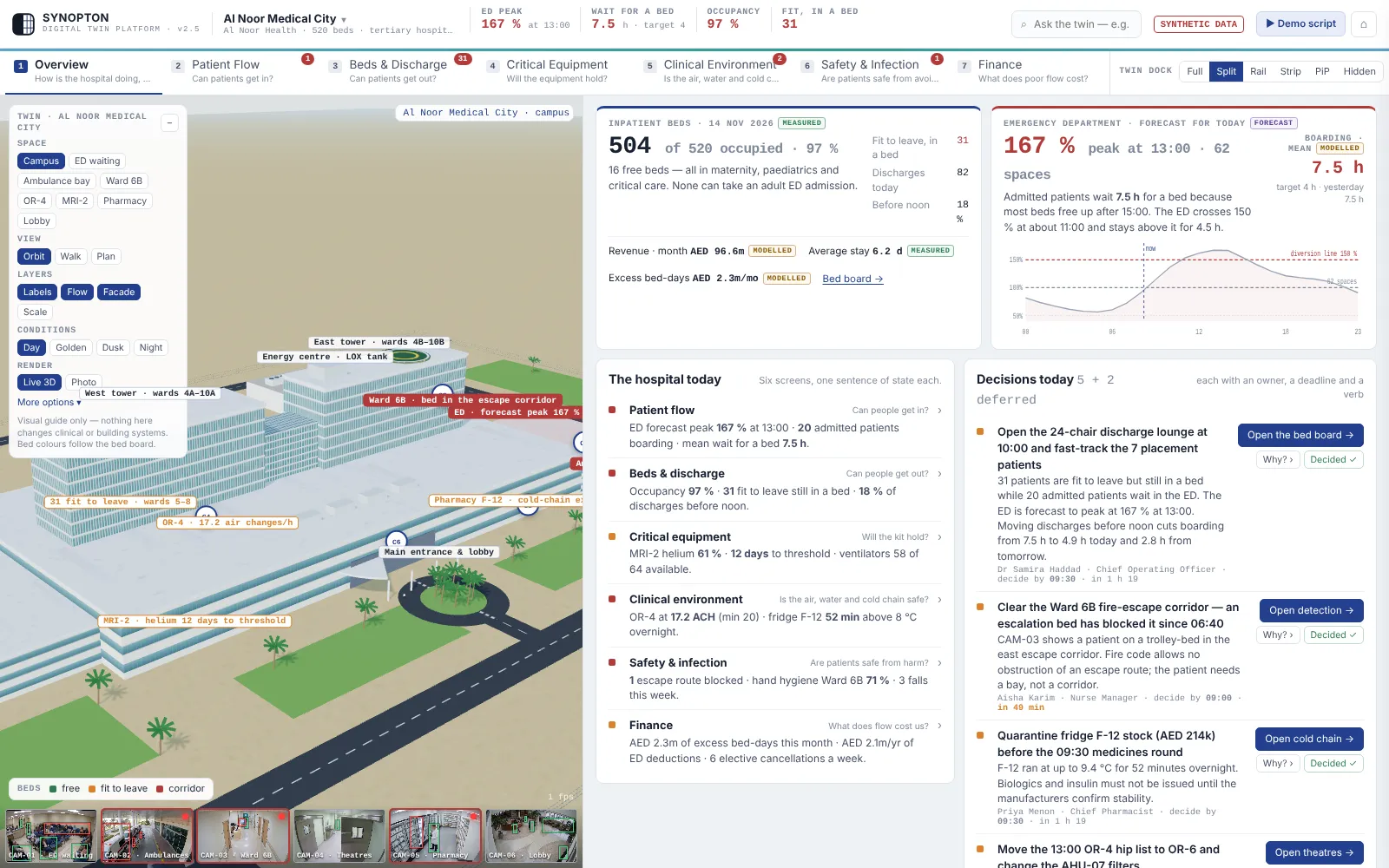
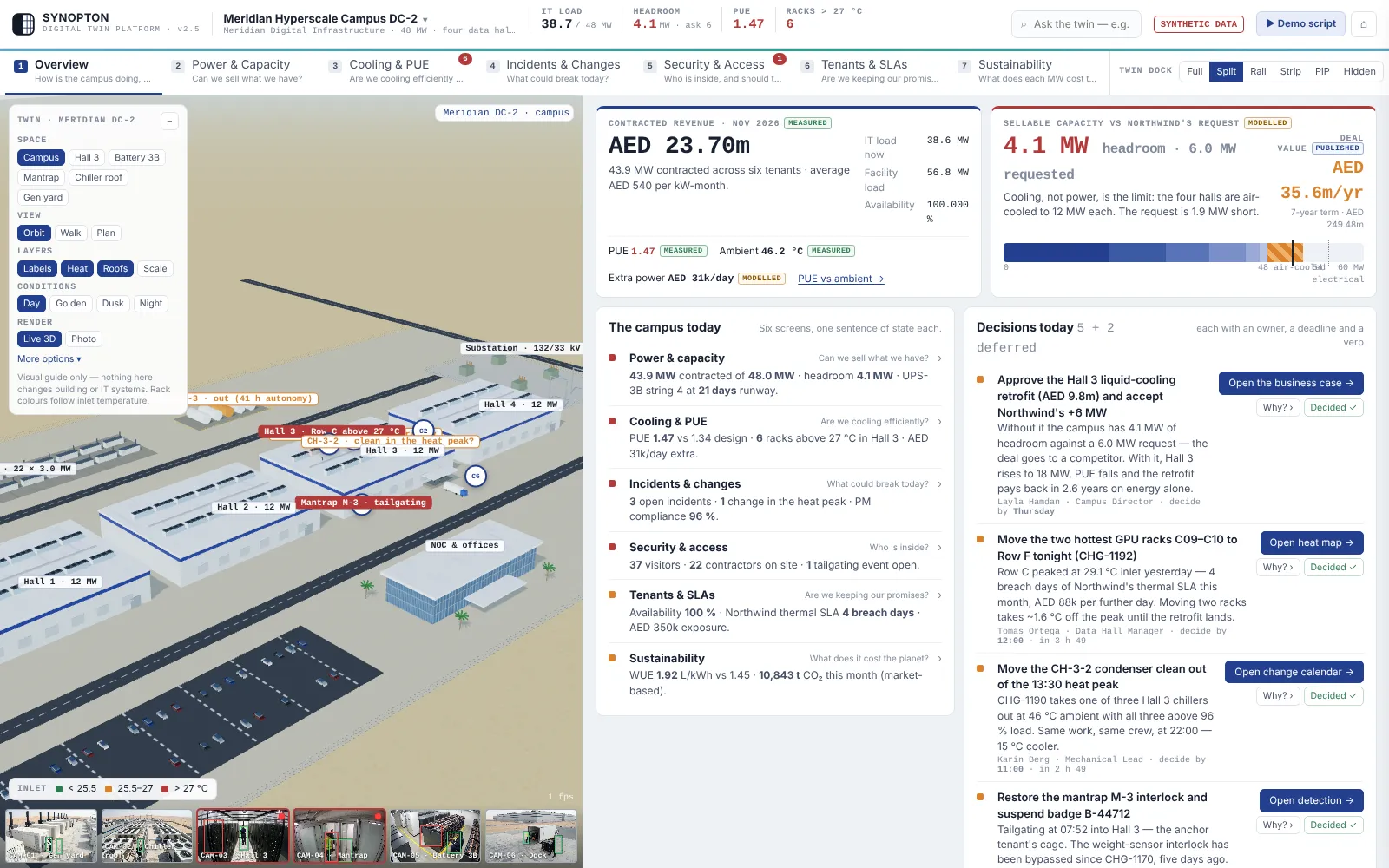
Synopton builds a live 3D twin of the hub and connects it, read-only, to the systems you already run:
- The WMS, yard and dock management, and the dock schedule
- Carrier contracts and client contracts, with their free time, fees and credits
- The robot fleet manager, forklift telematics and the CMMS
- Cold-chain probes and door sensors
- The CCTV you already own, with detectors for truck queues, door states and forklift near misses
Every truck, door, pick face and client SLA sits on the asset it depends on, with a price attached. Ask "why are trucks waiting?" and the answer cites the twin's own data: arrivals by hour, doors open, free time used, fees accruing.
Three levers, priced on the same trucks
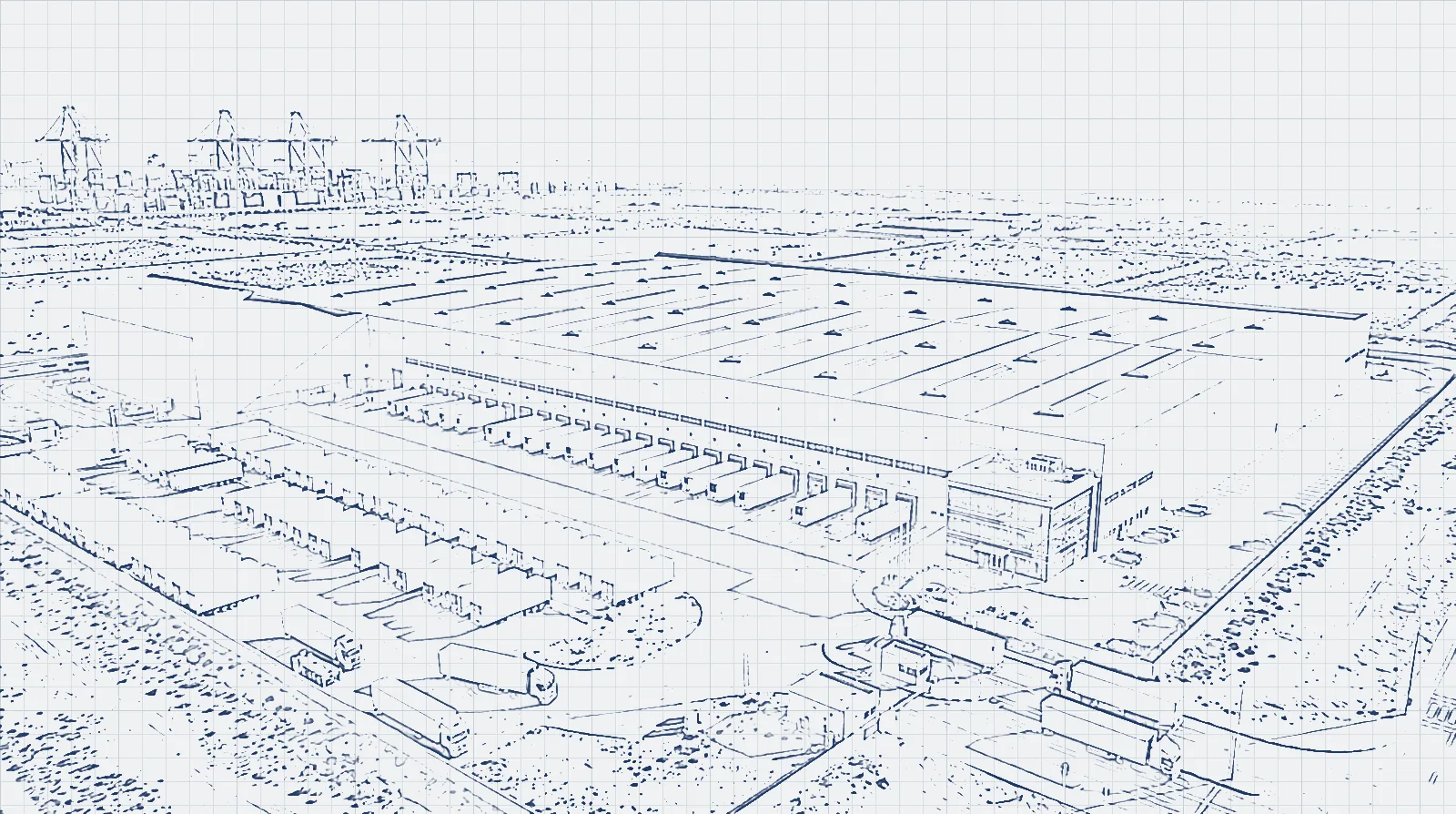
The twin re-runs the day under each option, using the same arrivals. In the demo hub, Falcon Gateway DC (120,000 m², 64 dock doors, 13 clients), peak brings 410 inbound trucks a day against 300 normally. Trucks wait 3.3 hours on average, 113 are queuing by 11:00, and carriers bill AED 108k a day in waiting fees.
- Night receiving window. Open part of the inbound doors overnight, so arrivals spread over more hours.
- Booked dock slots. Carriers book a window instead of turning up at dawn, so the queue never forms.
- Night replenishment. Move pick-face replenishment to the night shift, so day forklifts stay on unloading.
Together, the plan costs AED 16k a day in the demo. The average wait falls to 12 minutes, the largest client moves from 96.8% to 99.3% on time against a 98.5% target, and a peak day costs AED 19k instead of AED 118k. The alternative, an overflow warehouse, costs AED 94k a day all in and still leaves a 2.1-hour wait. Demo names and figures are illustrative; the pilot computes yours.
Why the numbers hold up in a client review
Every figure carries a label: measured, modelled, published, assumed or forecast. Waiting time from the gate camera is measured. The fee comes from the carrier contract, so it is published. The effect of booked slots is modelled until you run it. One click on Why? shows the inputs, the rule version and the sources, which is exactly what a client asks for before it renews.
Accepting a plan drafts a decision record with an owner and a deadline. The twin then tracks the measured result, so next peak you know what each lever really delivered.
What it costs
We quote after a 30-minute scoping call, based on the number of sites, data sources and cameras. The pilot runs on one hub with your own data for a fixed fee agreed at scoping, credited against the first year if you continue. After that it is an annual subscription per site. See how the pilot works, or open the logistics twin page for what it watches.
Fix the gate before next peak
Send us the hub, your peak dates and the client you cannot afford to lose. Email info@synopton.com or book a scoping call, and you get the full demo straight away.
Questions buyers ask
Do we need a BIM model of the warehouse?
No. We build the 3D twin from the site plan, racking layouts, the dock schedule and an equipment list. If you have BIM, IFC or GLB models, we load them.
Does Synopton write to our WMS, yard system or robot fleet?
No. Connectors are read-only. Accepting a recommendation drafts a decision record for people to agree; nothing is written back to the WMS, the yard system or the robots.
How are client data and camera footage handled?
Client order data stays in your tenancy and staff references are masked by default. Camera detectors measure truck queues, door states and the distance between people and forklifts. Faces are never stored, and revealing a name is written to the audit log.
Can we test one lever before changing the whole schedule?
Yes. Each lever is priced on its own and in combination, so you can trial booked slots with two carriers first and let the twin measure the result.
Your site, your data
Want to see what peak costs your hub?
Tell us the asset and the question it has to answer. You get the full demo straight away, and we come back within one working day to book 30 minutes.